Posts Tagged ‘David Allen’

friday-the-13th-art_original

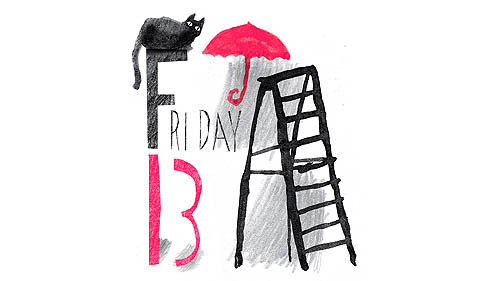
FRIDAY THE THIRTEENTH

It’s Friday the Thirteenth
A time to celebrate
We gather for a party
When we reach this date.

We’re the Thirteen Club
No Friggatriskaideka-phobics we
We eat at salt covered tables
And light our smokes by threes.

We hail the Norse goddess
For whom this day is named
We cross two knives at our table
And won’t let chopsticks be blamed

By standing straight up in the rice bowl
(That’s an Asian myth, you know)
And we love walking under ladders
Smashing mirrors as we go.

At home, when we get ready
Trimming our nails before we go,
We leave hats on beds and shoes on tables
Crossing off those obscure no-nos.

On the way to the bash we make sure
We let a black cat cross our path
And opening umbrellas indoors
Always makes us laugh.

We never go out doors that we come in
And pass graveyards at a walk
We chase each other with brooms
And engage in heretical talk.

We all hail the doomed Judas
The 13th guest at Christ’s last sup
And make note Christ was killed on Friday
Did he know his number was up?

It’s the day some say Eve gave Adam the apple
And you know what that act meant
The superstitious say this omen
Meant our good luck is all spent.

Well, we’ve sung this ditty
(Singing at the table’s one more taboo)
And no lightning bolt has struck us
We wish the same good luck to you.

By David Allen
13 June 2014

Like my poetry? Then buy my book, “The Story So Far,” published by Writers Ink Press, Long Island, N.Y. You can find it on Amazon.com (http://www.amazon.com/Story-So-Far-David-Allen/dp/0925062480/ref=sr_1_13?s=books&ie=UTF8&qid=1397184666&sr=1-13&keywords=the+story+so+far) in paperback and Kindle formats, or by sending me $10 at:

David Allen
803 Avalon Lane
Chesterfield, IN 46017

NotebookEngrish (1)


NOTEBOOK JAPLISH

I love Japanese notebooks
They always contain Zen-like messages in English.
For instance, a small notebook I found in my drawer last night
States on its cover that,“You can write down anything you want.”
I think I will.

I examine the other notebooks bought at 100-Yen stores
And brought to my new Indiana home.
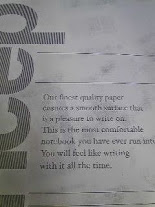
“This is the most comfortable notebook
You have ever run into,” one states.
“You will feel like writing with it all the time.”
I did.

I also filled the one that had frolicking
Yellow bush hogs on the cover.
“Hey, come together!” they said.
“Let’s all play together.
What kind of play do you like?
Everyone likes playing more than
Anything else. Don’t go far away!
Who is crying? No one can
Keep quiet at all.”
I can’t.

Makes you wonder, doesn’t it?
This writing, called Japlish,
Also appears on T-shirts, store signs,
And almost everything printed in English
In Japan. They often say more than they are meant to.
“SCRIBBLE” another notebook shouts.
“This notebook for scribbling the flash.”
Sounds like writing poetry.

I once asked a Japanese friend
About this fractured English.
She said the Japanese are fascinated
By English. It’s trendy to use
But no one cares about accuracy,
And apparently no native English speaker
Has ever been hired to edit the sayings.

“We wish that your life
Is going to be fabulously enjoyable,”
Another notebook proclaimed.
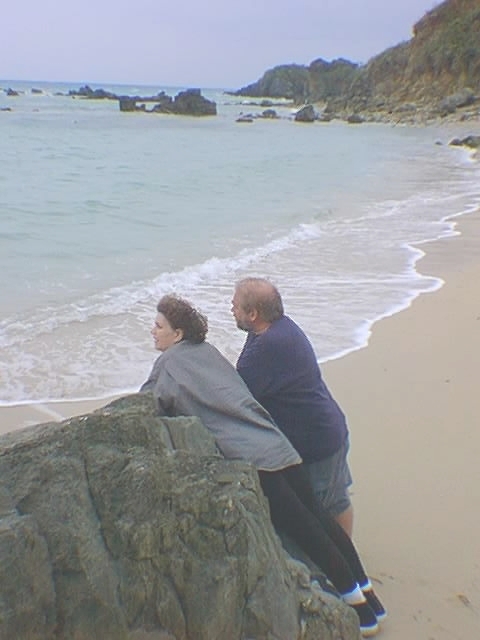
I used it while sitting at a picnic table
On a beach on the East China Sea.
My life at that moment was certainly
Fabulously enjoyable.

I don’t buy my friend’s description
Of the Japlish found on these covers.
For me, they are some kind of
Warped Zen lessons, their meaning
Akin to the convoluted answers the Masters give
To curious students searching for the truth.

“Let’s enjoy your life,”
One crimson colored notebook suggests.
“Sometimes you can do it only with lovely color.”
Oh yeah, catch that rainbow.
“I’m a favorite of this circus,” another brags.
“I’m very happy in this showtimes.”
I am, too.

The next notebook pulled from the drawer states,
“BE FREE! Let’s get happiness!”
I try, and laugh at the next title,
“For you, I always think of your thing.”
And what is your thing?

The next book answers:
“What can you do on Sunday
If you can ride a cloud?
A slow hour passes while having
A loose wind have been blown.
By the way, please, teach it somewhere.”
I’ll try.

Another book tells me:
“Aiming high is much valuable
Through one’s life.”
Or, as the last book announces,
“We’re having a spell of mind weather.”

And I don’t mind.

By David Allen

Like my poetry? Then buy my book, “The Story So Far,” published by Writers Ink Press, Long Island, N.Y. You can find it on Amazon.com (http://www.amazon.com/Story-So-Far-David-Allen/dp/0925062480/ref=sr_1_13?s=books&ie=UTF8&qid=1397184666&sr=1-13&keywords=the+story+so+far) in paperback and Kindle formats, or by sending me $10 at:

David Allen
803 Avalon Lane
Chesterfield, IN 46017

NO ENDING

Posted: June 10, 2014 in Poetry
Tags: , , ,

suicide2

NO ENDING

Some people laud suicide
As the perfect ending
To life’s tragic story.
But my life’s more
Like some comedy,
A serial with chapter endings
That keep me anxious
To read on,
Wondering just what
In the world
Will happen next.

                                          By David Allen


Like my poetry? Then buy my book, “The Story So Far,” published by Writers Ink Press, Long Island, N.Y. You can find it on Amazon.com (http://www.amazon.com/Story-So-Far-David-Allen/dp/0925062480/ref=sr_1_13?s=books&ie=UTF8&qid=1397184666&sr=1-13&keywords=the+story+so+far) in paperback and Kindle formats, or by sending me $10 at:

David Allen
803 Avalon Lane
Chesterfield, IN 46017


DSCF0013 MISC PIX 2 069


WHAT I DID ON MY SUMMER VACATION IN OCTOBER
or
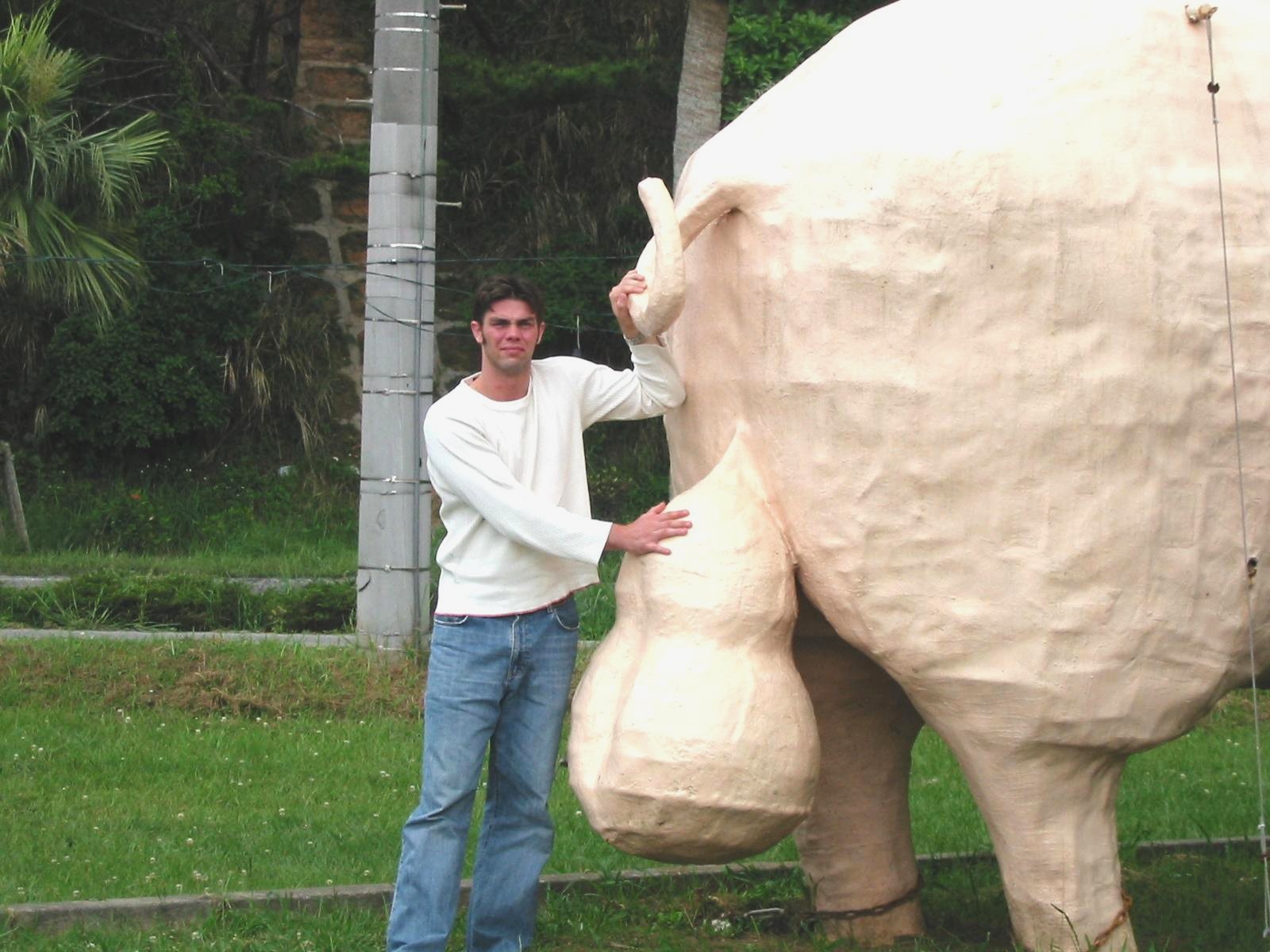
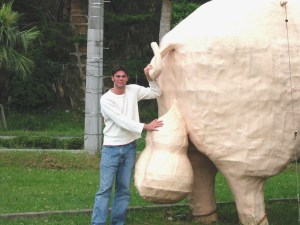
SOMEONE PAINTED THE PIG’S BALLS BLUE

Prelude:

The paycheck stub
says use or lose
so, I choose
vacation —
V-A-C-A-T-I-O-N
This is how it went.

Day One:

I read poems
and the earth moves.
Miles below us
the earth rocks —
no connection.
“The crowd was
pretty silent,” I say,
returning to my seat.
“We were all wondering
whether to run,” Ruth Ellen answers.
Again, no connection.

Day Two:

Sunday
rain followed by rain
with a little more rain,
a drowsy, kind of
sleep in day to make
the transition to vacation.
Pizza Man,
up to his ankles in water,
braving the flood,
delivering the meatrageous.
Diets be damned,
we’re on vacation!

Day Three:

Rain at dawn;
what a surprise!
It rains cats and dogs,
fish and frogs;
it pours in buckets,
falls straight in sheets,
it rains blankets —
hell, it rains the whole damn mattress.
We shop for last
minute things and buy
what impulse brings.

Day Four:

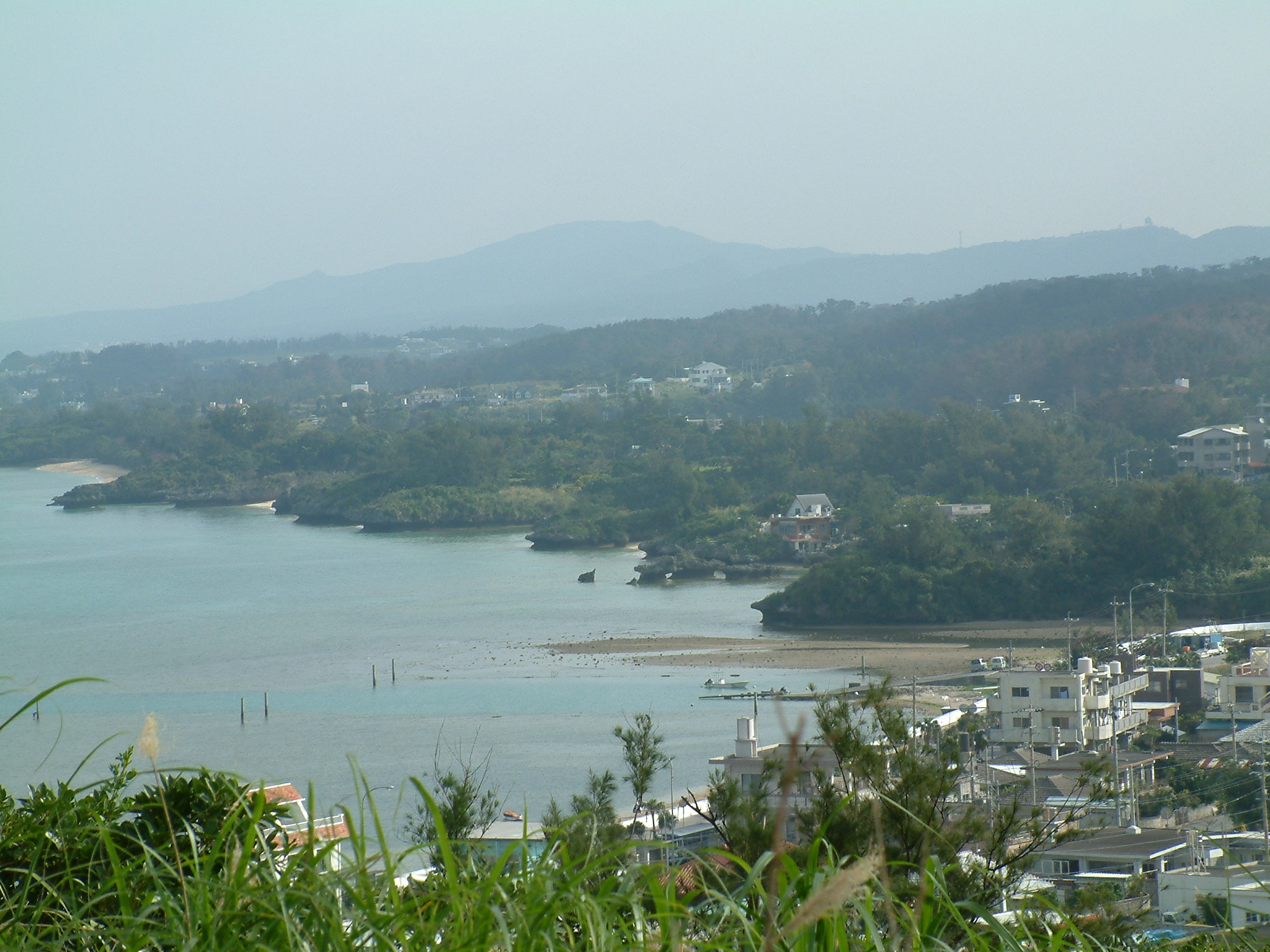
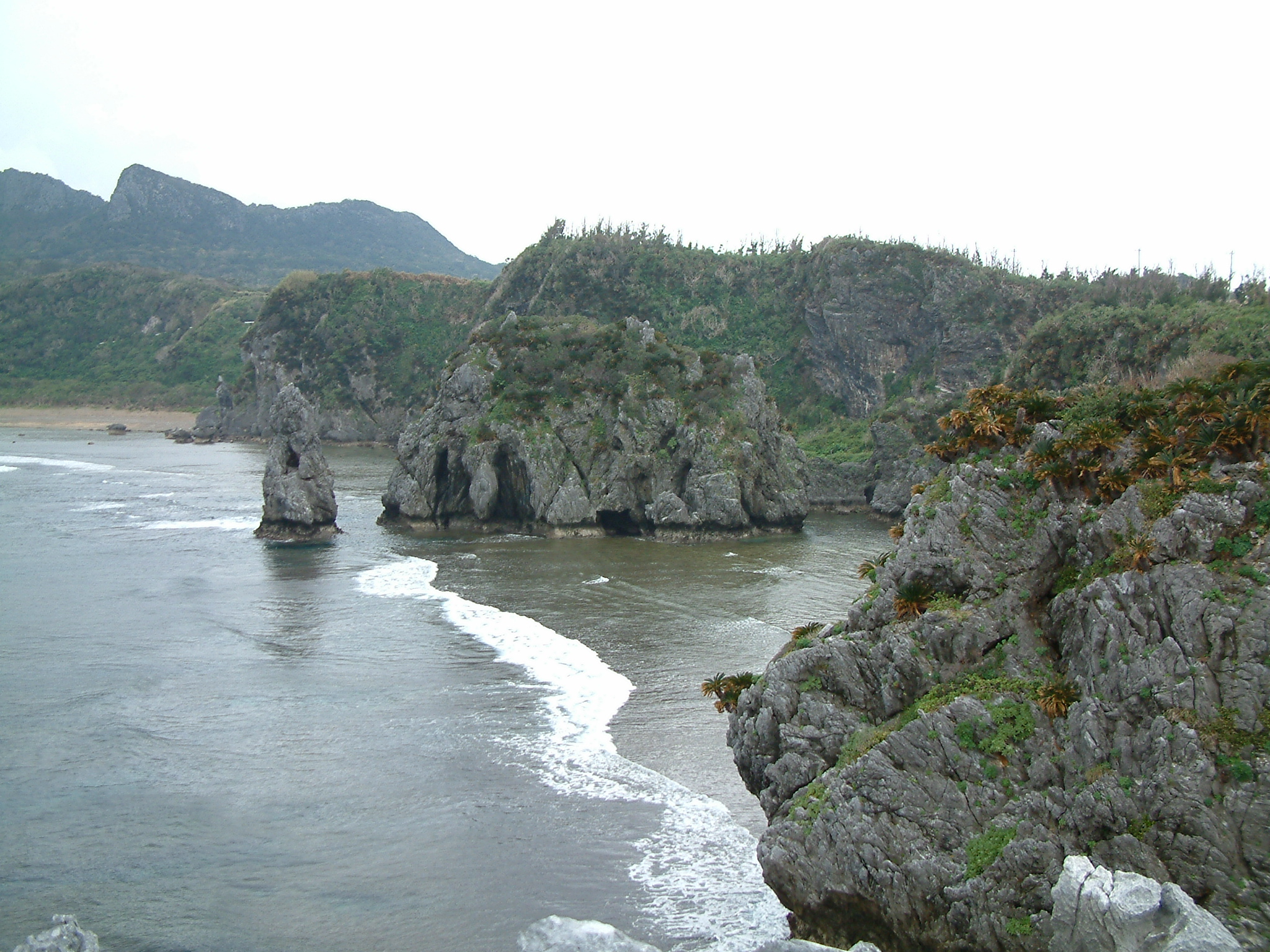
Off for the fair shores of Okuma,
North island mountains,
sandy seashore. We’re off
to bathe ourselves in sunshine.
But first, we must survive the rain.
It rains so hard
we can’t tell sea from sky
and the road is a river
of water looking
for an open drain.
Kadena Circle is a fog of spray
cars fishtail, wipers
futilely beat at the rain
slapping time to
a Buffett refrain.
At the Kina slaughterhouse
and restaurant someone
painted the pig’s balls blue.
An omen, ‘cause just outside
of Nago the blue sky
breaks through.
Mountains steamy,
wisps of clouds play
in and out the window
through the folds.
Salvador Dali slopes,
cement slabs slide
down the mountainside —
no falling rocks here.
109-0912_IMG

The road narrows,
double lanes hug the coast.
Shioya Bridge, it pleases me
to drive through your bright red arches
before your featureless brother
takes your place.

And then — Okuma!
“No bottled beverages
allowed in this facility.”
Quick, hide
the long-necked Becks.

Ruth Ellen, trusted
navigator, willing scribe,
says the poem’s taking
epic proportions:

By the shores of great Okuma
I bit deep into my burger,
burger smothered rich with mushrooms
covered with a coat of cheese.
I bit deep into my burger
and let out a moan of pleasure,
startling my lunch companion
who said, “Well, I see you’re pleased.
You never moan so loud when we’re together
doing the dance of mare and stallion;
(Oh, the pickle and the onion)
No, you never moan so loud
on the nights we roll in bed.”
I could only nod my head,
for I was no Indian brave,
and it was the Cheeseburger in Paradise
that I had craved
since before the trip began.

Day Five:

Inaccuweather calls for
scattered showers
interrupted by torrents.
During a sun break, we
try snorkeling, but
Mother Ocean’s strong current
threatens to carry us away.
“Not yet, not today!”
we shout, as we leave Robinson Crusoe
footprints in the sand.
“There’s adventure ahead.
We’re on vacation, dammit!”

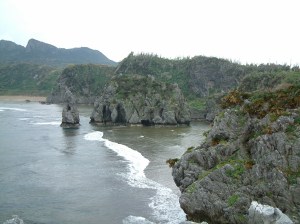
The way to beat the clouds
is to drive into them.
Cross Highway 58,
past the turnoff to Higa Falls,
and up, up, up
the snaking mountain road
that twists and turns
like a woman’s body,
caressing the curves,
finessing them with convex
mirrors, we drive through
the clouds forming
in the valleys below.
DSCF0076

Mile, after mile
and not another soul.
At spots the jungle threatens
to reclaim the road,
eliminate all trace of the
concrete ribbon rising
up, up, up
and around and down
and up again.
A little traveled trail,
a patchy asphalt one-lane
almost-path branches
off, beckons.
Dare we take it?
Dare we not?

Our Honda Shuttle
was not made for such
adventure, but handles
well the trail, so unused
that at parts vast spider
webs — spider condos —
block our passage.
Rain droplets, like diamonds,
hang from the silk.
Ruth Ellen gently
brushes them aside
with a big stick.
Hard work,
the intricate webs
are strongly anchored
and she is sprung back
a few attempts
before she clears a path.
“I didn’t want to ruin
such art,” she says
as we roll onward,
ever upward, under
the canopy of trees.

Suddenly, bright yellow posts
mark the edge of the trail.
“USMC,” they are stamped.
We wonder what that means.
But no one said “Keep Out.”
So we continue our climb.
Beside us, steep drops
down the rocky, jungle slopes.
We stop and stand at the edge
and all we see is a
carpet of green, mile after
mile of mountain,
inviting,
embracing,
nurturing.
We stand, and with
upraised arms we shout,
“Top O’ the world, Ma!
Top O’ the World!”

The trail ends abruptly,
an anticlimax at
a barbwired U.S.
Army enclosure,
a microwave tower,
concrete and steel
monstrosity, way out
of place here in Heaven.

Reluctantly, we turn and trek
back down the trail
of the banana spiders.
On the main road,
on a rare straight stretch,
a sign in kanji and English shouts:
“Speed Down!”
Of course!
Speed down!
There is no incessant voice
from Tokyo, some editor
demanding 10 more inches
of copy in 15 minutes.
There’s no newshole
for the newswhores to fill.
Speed Down! and smell the —
well, hibiscus and pineapple
will have to substitute for the
fabled roses.
Speed Down!
and smell the ocean.
“Speed Down!” it shouts,
(“You’re on vacation.”)

Day Six:
A bad body day means spending the time
inside, reading to my soulmate as she
fights the phantom pain the disease insists
is the price for a few pain-less, or rather
less pain-filled days.
(Pain and fatigue play
their game upon the field
that is her body;
sometimes, like soccer,
scoreless, some sweet succor,
sometimes running up the score.
They are in double digits today.)

Yet, she still serves me a grimace
with a smile chaser as I
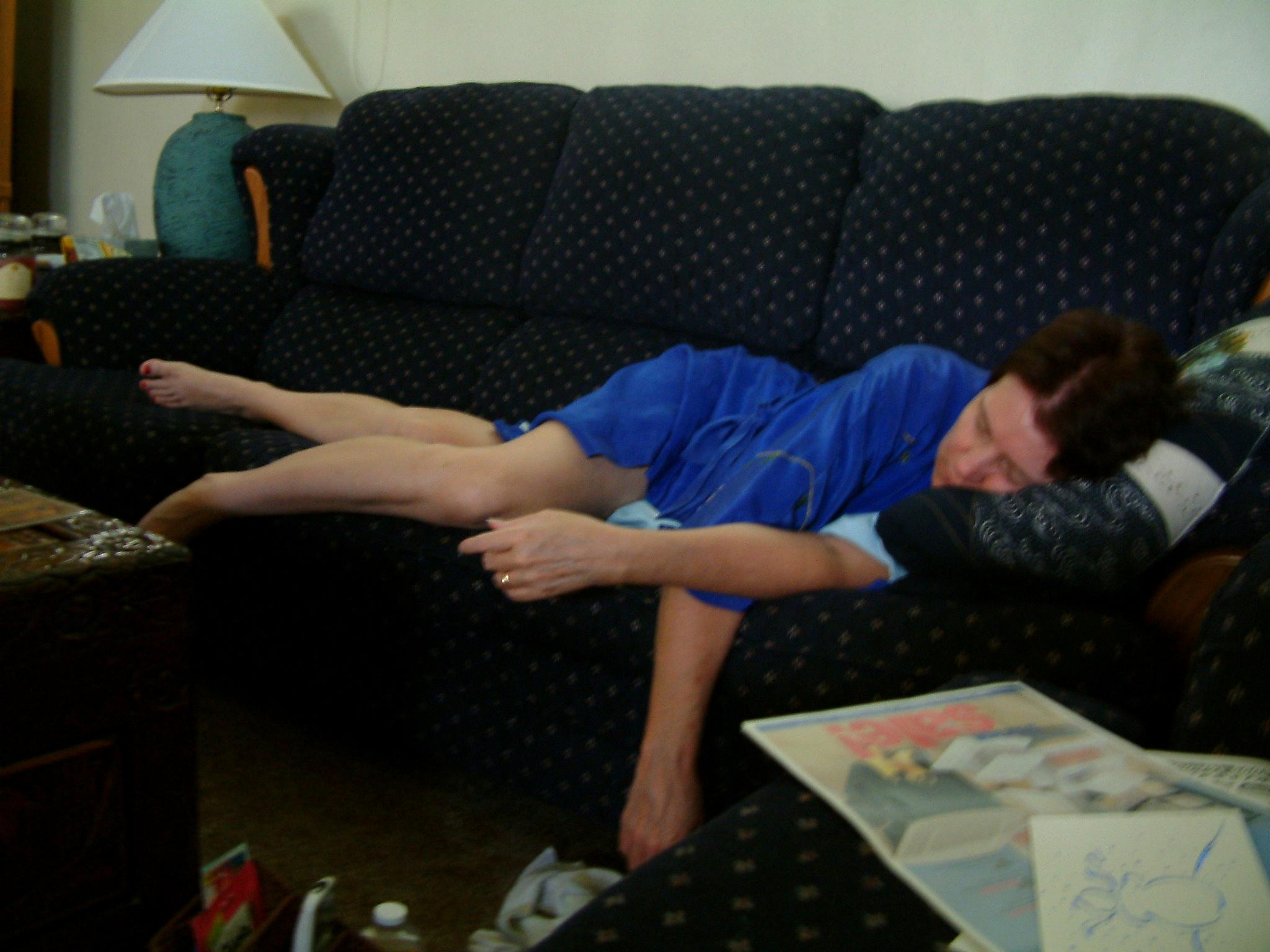
read her to sleep —
e.e.cummings’
“I six nonlectures,”
A book borrowed from
a new young poet friend
just discovering his muse
(how I envy the paths he has yet to tread,
the poems and books yet to be read).

And in the reading,
‘ while she dozes and wakes,
drifts in and out of painfullness
I discover ee cummings’
nonlecture on what
a poet is:

“If you wish to follow
even at a distance,
the poet’s calling…
you’ve got to come out
of the measurable doing universe
into the unmeasurable house of being.
If poetry is your goal
you’ve got to forget
all about punishments and
all about rewards and
all about selfstyled obligations
and duties and responsibilities
etcetra ad infinitum
and remember one thing only —
that it’s you, nobody else, who
determines your destiny and decides your fate.
Nobody else can live for you,
nor can you live for anyone else.”

And so, I read to my wife,
my muse, my partner in
life’s discourse and spend
the most pleasurable day
of my vacation.
OKI9

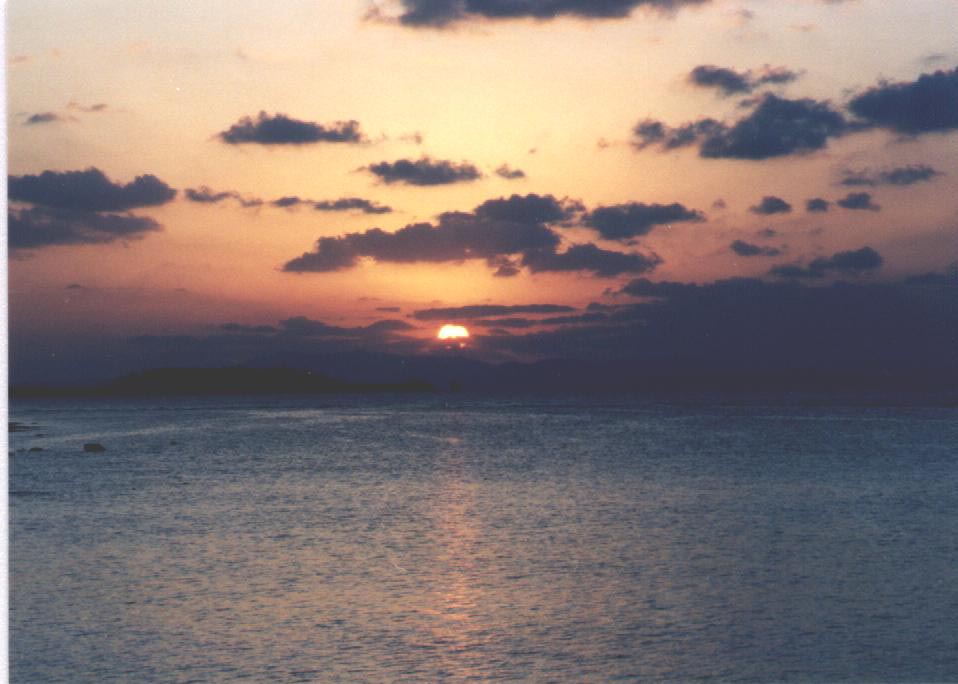
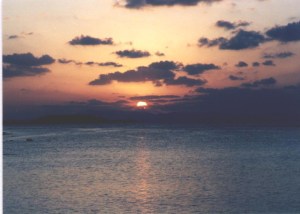
At night, dinner with a sunset for dessert.
The thing I like about sunsets best
is, just as the leading lady leaves the stage,
the whole sky explodes in colorfullness,
an ovation for another day well done.
My love loves best
this dimming of the day
when all cares and pain
like butter melt away
and, like an old friend,
the night comes to cloak our nakedness
with a fine silk robe.

Day Seven:

On the Seventh Day I wish
I could say we rested,
but instead we drove
as the sun shone strong
back home to where our worries
and cares waited, pouting children
mad we didn’t take them along.


By David Allen
Okuma, Okinawa
October 1998

Like my poetry? Then buy my book, “The Story So Far,” published by Writers Ink Press, Long Island, N.Y. You can find it on Amazon.com (http://www.amazon.com/Story-So-Far-David-Allen/dp/0925062480/ref=sr_1_13?s=books&ie=UTF8&qid=1397184666&sr=1-13&keywords=the+story+so+far) in paperback and Kindle formats, or by sending$10 to:
David Allen
803 Avalon Lane
Chesterfield, IN 4603

SLEEPER

AS MY LOVE LAY DECLINING

As my love is tied
against the ropes,
the disease delivering
jarring jabs,
but no knockout blows,
I watch outside the ring
observing the slow
destruction of the body
for which I ache.
I want to embrace her,
but she is in the ring
with disease.
The referee, Death,
ignores the headbutting
and blows beneath the belt.
I want to jump into the ring,
to stand in for her,
take it on the chin.
But the best I can do
is wait in her corner
with a bucket of fear
for her to spit in
and a towel of love
to wipe away
the sweat
and tears
and blood.

By David Allen

Like my poetry? Then buy my book, “The Story So Far,” published by Writers Ink Press, Long Island, N.Y. You can find it on Amazon.com (http://www.amazon.com/Story-So-Far-David-Allen/dp/0925062480/ref=sr_1_13?s=books&ie=UTF8&qid=1397184666&sr=1-13&keywords=the+story+so+far) in paperback and Kindle formats, or by sending$10 to:

David Allen
803 Avalon Lane
Chesterfield, IN 46017


Okinawa courtroom

ANOTHER DAY

Another day
another trial
another judgment.
I wonder if there is
some newshound
hanging around
the Pearly Gates
waiting to report
about me
when I am judged,
for all my faults,
for all my sins,
as insignificant
as I believe them to be?

By David Allen

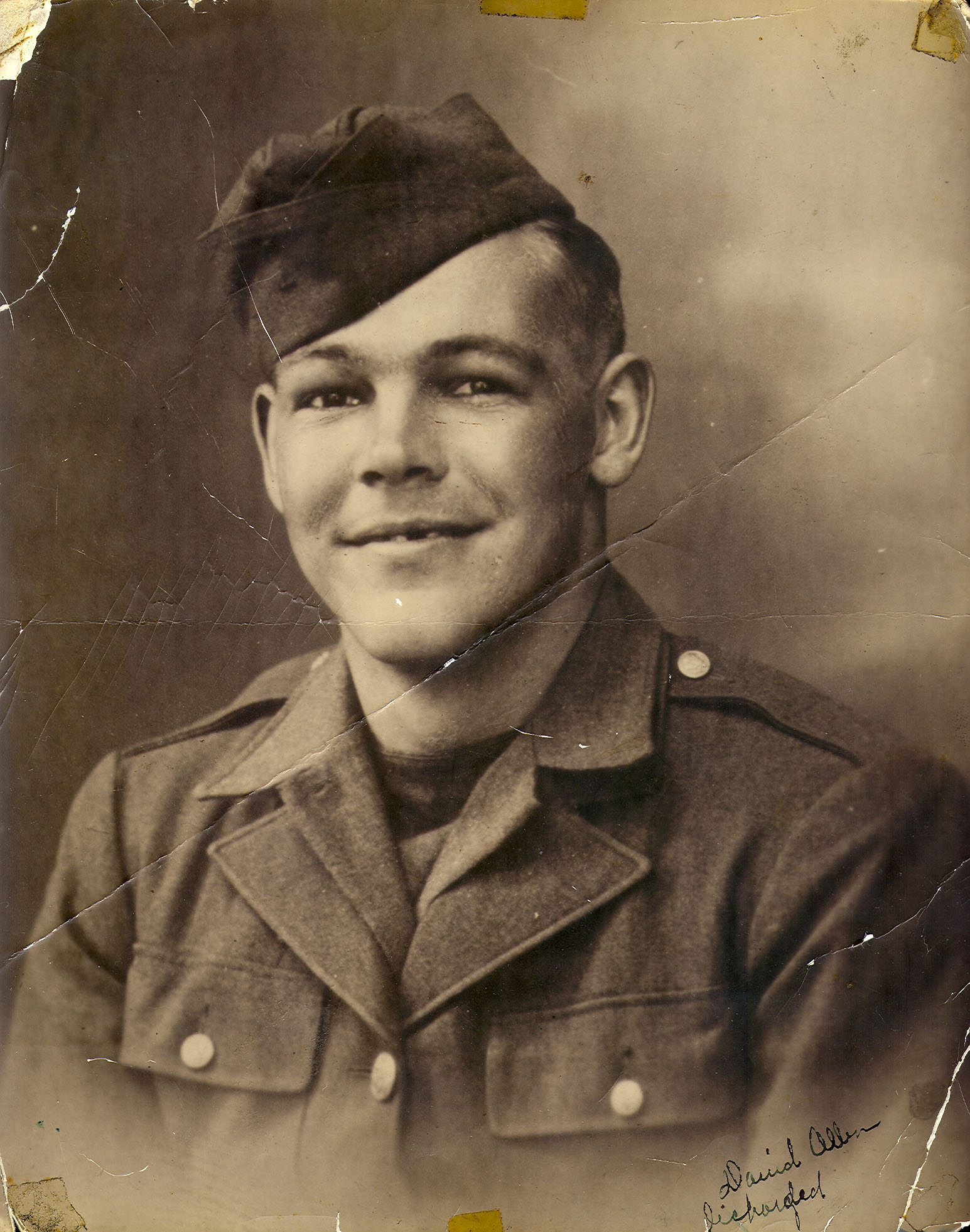
David Leroy Allen WWII

David L. Allen, 1942
A Memorial Day Poem

REQUIEM FOR MY FATHER

Jeannie called and said
“David, Dad’s dead.
He fell and bumped his head.”
And inside I bled
for a man long dead
in memories
of a family
that used to be.

Jeanie was calm.
She said our Mom
was all right,
though “she just sat and stared.”
And I cried then,
but I don’t know why when
you had died ten,
twenty years ago.

You had fled
to your dark bed-tomb
and you left that crypt,
that stenched of rotting dreams
and surrender,
only for soft drinks
and to pee.

So, I called Ricky, the youngest,
and he said no tears tracked his cheeks.
“I’d been telling everyone
my Dad died years ago,” he said.

Ricky said:
“I once asked Dad what he was going to do today.
He said: Nothin’.
I said what about tomorrow?
And he said: Nothin’.
And I asked him how could he give up
after surviving World War II and alcohol?
And he said: Leave me alone.
And I told him he had to leave his room or die
And he said: Ricky, I only leave the room to pee.
And I repeated, if you don’t leave the room you’ll die.
And he said: Nobody can tell me what to do.”

Nobody could.

Mom wrote last week,
said you were doing less
and less for yourself;
that Kathy had come by to shave you;
that you and Mom were to celebrate
your 50th wedding anniversary.
She said she didn’t know how you two
had stayed together so long.

You didn’t.

‘Til death did you part.
But which death?
This final, no-breath death of today?
Or the thousand times you died since the war?

We, your children, are the products
of the half-man, half-soldier, Mom welcomed home.
The best part was left in the rubble
of a bombed-shattered wine cellar near Bastogne.
You were the sole survivor of your squad,
a heavy burden to bring back home,
a burden laid on your children.

The tag you wore around your neck
when you awoke in some hospital,
safe behind the lines said:
“This man is not responsible
for his actions.”

You never were.

You never recovered.
Booze, your best buddy,
carried you through your days —
from job to job,
child to child,
town to town.

At least we older children have memories
of a man, crippled perhaps, yet still struggling
still searching to retain some semblance of living;
pictures of a smiling man in a fireman’s dress blues
posturing before a neat Levittown bungalow.
Flash forward:
a man in shabbier clothes,
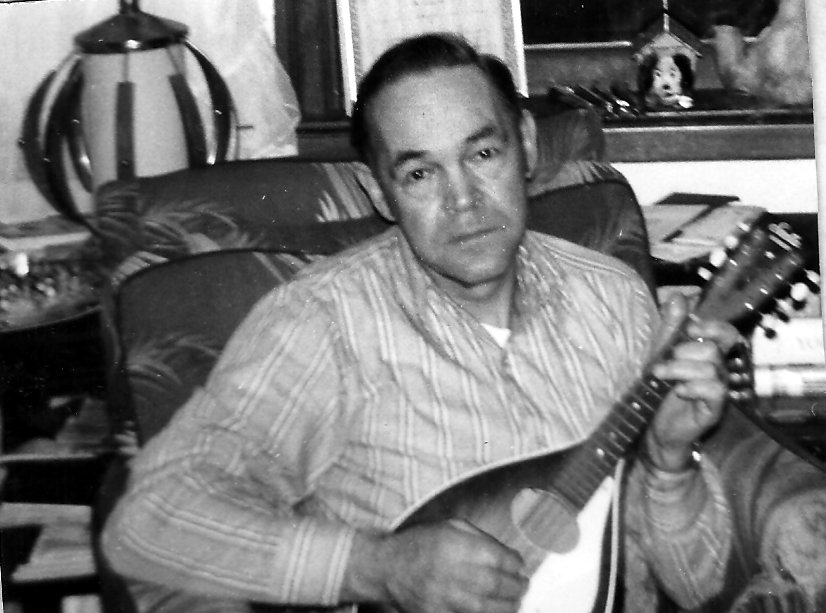
tilted cowboy hat, sad smile,
playing a mandolin in a boozy haze —
yet picking those strings,
making her sing.

But never loud nor long enough to heal the wounds.

In poverty, Mom raised us
as you struggled with your demons;
your days haunted by ghosts of what were
and could have been.
I left home first,
tasted the salt sea air of freedom
and returned to find another man
wearing my father’s clothes.

You were booze free, but hooked on pills
that still could not ease your pain.

Twenty more years passed
and you became another kind of Dad
for the younger ones.
No more booze,
no more belts across bare buttocks.
You went to AA and, for awhile, held court
at the dinner table,
telling bad jokes and drinking soda.

But your nerves were shot,
you couldn’t work,
only the pill-induced sleep stopped the demons.
So you retreated from the world,
no more morning walks for the paper,
no more evening talks at the table.

The bed tomb beckoned.

The tube flickered in the dark,
images of the world you turned your back on.

These last years
we visted Mom and brought reluctant children
into your cave to say
Hi and bye to their Pop
(I never called you that).
They cringed to see the unwashed man
with inch-long toenails,
shaggy hair,
swollen Buddah belly
glazed eyes.

My kids don’t remember much, Dad.
But I’ll try to recreate the memories.
I’ll tell them about the war hero;
the tank killer;
the high school football star;
the cartoonist;
the musician;
the man;
The slender Yankee with the toothy grin
and easygoin’ manner that
swept our Southern Mom off her feet
and into the Allens.

I’ll remember for them
the Demon-less Dad
I tell myself
was hiding there
all along.

By David Allen

Carnathy 1

CARNATHY

Walked the narrow streets
of Colon last night,
boldy wearing the blue SP armband,
nightstick twirling, my 5-foot 2-inch skinny ass
flanked by two of the biggest Marines
I had ever seen.
Feeling cocky in the Caribbean,
a world away from the fray in Vietnam.
‘Round about midnight,
prodding the drunks back to the ship,
we spied a young Marine sitting in the doorway
of a century-old storefront, sobbing .

“God, God! Where are you?” he cried.
“God, God, where are you?”
Over and over he slurred the words
between garbled bits of barely audible sighs.

One of the Marine SPs, recognizing his friend,
bent over him, placing a hand on his shoulder.
“Carnathy, what’s wrong, man?”
Carnathy had blood on his blouse and a cut
on his distorted, drunken face.
“He’s dead!” Carnathy wailed.
“My buddy – they killed him!”
“Who, man?” the Marine asked.
“He had no name and
he looked just like me.
He’s dead!”

Carnathy convulsed into
a stream of nonstop sobs,
then screamed,
“I told him God was dead
and he believed me!”

The Marine SPs helped him to his feet.
Carnathy slumped in their arms,
repeating his wail,
“I told him God was dead
and he believed me!”
They walked him back toward the ship,
strong arms tenderly lifting,
gently helping him along.

“Carnathy sometimes gets like this,”
his friend told me as I tagged behind.
“He used to be religious
until he got freaked out and lost God
in a bunker during a mortar attack.”

As the ship grew in sight,
Carnathy straightened,
yelled and jerked away,
stumbling, running for the darkness.
We chased him, found him huddled,
hiding in a clump of bushes.
He came up swinging,
but his drunken assault
was no match for
sober wits and nightsticks.

His friends dragged him back to the ship.
“Take me, take me to my death!”
Carnathy cried.
“Go ahead, you bastards, God is dead!
God sucks! I want to die!”

The next day, Carnathy was flown to
a hospital and a discharge in San Juan.
I was on the ships’ fantail,
gossiping over morning coffee,
when I learned that just before
we found him Carnathy
had been in a fight with
a lifer he had tried to convince of
God’s absence from the world.
The lifer called him a weak crybaby
and a disgrace to the Corps.

Just another day
protecting the Caribbean
from communism.

By David Allen
20 October 1967

NOTE: Here’s a Memorial Day poem from the archives.

crime 3

NORMAN

Damn!
Damn, my chest hurts,
motherfucker must’ve popped me
with a 9 millimeter.
Getting capped with a .22
wouldn’t feel this bad.
Shit!
Where’d he come from?
And why?
I thought I left all that
gangbanging shit.
Man, got me a little boy
a good woman, a job –
left that crack street scene.
What happened?

God, it’s cold.
Wonder when someone’s gonna come
take me to the hospital?
What’s that?
Sirens.
Shit, took ‘em long enough,
Dude could bleed to death.
Least, the pain’s gone.
Damn, it’s cold!

Where am I?
Must be on my back,
alls I can see is
that bright streetlight
just outside my crib,
the light I useta shoot out
just for fun when I was I hangin’,
gotta keep our bidness in the dark
away from that bright light,
that inner city
halogen yellow.

Hey!
Shadow standing over me
squats, feels my wrist
pulls my eyelids up.
That shoulda hurt,
but didn’t. Shadow shakin’ his head.
Hey, c’mon, do somethin’
about that hole in my chest!

Hey!
I can’t seem to talk.
Mouth’s fulla blood, vomit
metallic taste, like some
piece of aluminum foil
stuck to my chewing gum.
Can’t move my lips.
Damn, it’s cold.

Shit!
Shoulda changed my underwear,
what’ll Momma say about that?
Cops’ll laugh.
God, it’s cold.
Shhhh! What’s that sound?

No sound.
Someone turned the volume off.
That can’t be right,
all kindsa sounds just a moment ago.
I heard those sirens,
shoes on concrete, running
that hurried, excited chatter;
some woman screaming,
the young dudes, the crack runners from the corner
those newbies I had working for me,
they were here,
I heard them talkin’ ‘bout
some dude got capped right in front of his own house.
I remember that talk now,
One said: “Hey, it’s that gone-straight gangster
Norman!
Hey, the Crips capped Norman!
He dead!”

What?
Dead?
Nah, I’m still thinkin’.
Stuff still going on in my head.
Damn, it’s cold.
Hey, there’s my boy!
Hey, junior!
Oh man, he’s bawlin’.
I can’t hear him, but I see his pretty mouth
all contorted, tears runnin’ down his…
Oh, Normie, baby
Daddy’s gonna be….
Hey!
Man, don’t take him away.

Hey!
Shadows coming close,
somethin’ being put over me.
Shit, it’s a sheet.
Man, why?
Come on now, stop jokin’.
Get me to a hospital
Damn, it’s cold.
Least the pain’s gone. Hope no one
sees I didn’t
change my underwear.
Damn,
Momma?

Mom?

By David Allen

NOTE: Norman was a former crack dealer and gang member in Fort Wayne, Indiana, back in the late 1980s. I was a cop reporter for the afternoon daily newspaper and covered his story, starting with his cleaning up and becoming a leader in working with the city’s growing gang problem to his murder.

My Father Played the Mandolin

MANDOLIN THERAPY

My father plays the mandolin
when life begins to close him in;
playing old folk tunes and country airs,
music helps to soothe his cares
and ease his life.

And he plays,
when the need for drink
clouds his brain
and he can’t think.

He plays,
when the bills are high
and cash is low
when my mother cries.

He plays,
into the night
but it never seems
to come out right.

He plays the mandolin
when life begins to close him in.

He plays.

BY David Allen

This is an early Fathers’s Day Poem. My dad was a WWII veteran who never fully recovered from combat. He was incredibly talented — a football hero at Manhasset High School, a cartoonist, a comedian, a musician — but he was also an alcoholic most of his life. After he gained sobriety when he was 43 years old, he became hooked on pills to treat his post traumatic stress disorder (which they didn’t call it back in the mid 60s). He died in 1992. (A poem about that will follow next month.) We were never really close. I was short, non-athletic, bookish and disobedient and he was disappointed with me. I was the oldest of seven children and ran away a lot.